
Today I want to bring you a case from the 1850s that shares many similarities with the Netflix dram Baby Reindeer, even down to the fact that the two main protagonists shared a Christian name and an occupation with the two characters in the series.
MARTHA SHARPE AND JAMES ELPHINSTONE
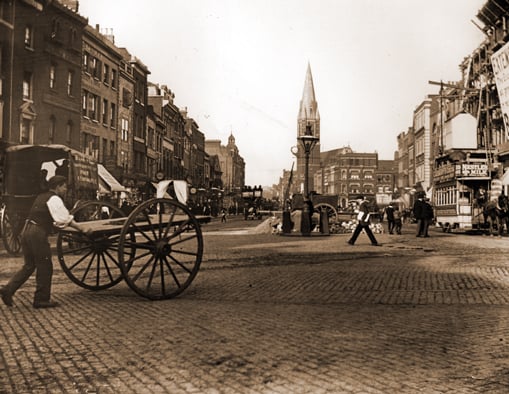
Reading accounts of the 19th century East End, you could be forgiven for perceiving it as a lawless, crime infested slum, on which the sun rarely shone, and where cultural pursuits were all but non-existent.
Whereas this was the case within small enclaves of the district, the Victorian East End was, by no means the bleak, uncultured backwater that it is often made out to have been.
For a start, it had a thriving theatre and music hall scene, and several of the stars of the age cut their dramatic teeth on the stages of the likes of The Royal Cambridge Music Hall on Commercial Street, Foresters, on Cambridge Heath Road; The Paragon, on Mile-end-road; and Marlow’s Music Hall, on Bow-road.
THE ROYAL PAVILION WHITECHAPEL ROAD
However, one of the East End’s most popular theatrical venues – and the East End’s first major theatre – was the Royal Pavilion on Whitechapel Road.
Built in 1827 on the site of a former factory, the Royal Pavilion – or simply The Pavilion as it was more commonly known – staged a diverse array of entertainments that ranged from Shakespeare to Cook’s celebrated company of Equestrian Artists, which included Paul Pry and His Wife On Horseback, and The Merry Miller’s Frolic.
In April 1846, audiences could even enjoy what was advertised as:- The long-promised gigantic Easter novelty with costly dresses, 150 in number, gorgeous scenery, splendid properties, banners, appointments, new music, dances, 60 fairies, and 80 female warriors.

JAMES HENRY WALKER ELPHINSTONE
One of the most popular performers at the Pavilion in the late 1840s and early 1850s was the comedian James Henry Walker Elphinstone.
Elphinstone was, in fact, an adopted stage name.
He had been born just plain James Henry Walker in the City of London Lying In Hospital on City Road in 1818.
On the 24th of August,1847, when he was 28 he married 17 year old Helen Norman at the Church of St Martin In The Fields, off Trafalgar Square.
For the next few years they lodged with his parents at number 48 Bishopsgate, a twenty or so minute walk from the Pavilion Theatre, so a convenient abode from which he could comfortably walk to work.
Soon, James and Helen had welcomed the first of their seven children into the world, and life seemed pretty decent for James Henry Walker Elphinstone, both professionally and personally.
A DARK CLOUD APPEARS
But, in 1850, a dark cloud drifted over his idyllic situation.
Towards the end of April that year, as Elphinstone strolled onto the stage each night, he began to notice two women that were in regular attendance at his performances.
Night after night, he would see them sitting in one of the boxes watching him, and one of them – a tall, pretty woman who looked to be in her mid-20’s – appeared particularly enamored with him, and she would laugh uproariously to the point of overreaction at his jokes, and gaze at him with a longing look of disconcerting intensity.
Unbeknownst to James Walker Elphinstone, he had acquired what today would be recognised as a stalker, and her obsession with him would almost have fatal consequences.
THE WIDOW MARTHA SHARPE
The two women were Sarah Holborough, the wife of a sailor, who lived on William Street, off Commercial Road, and her good friend, twenty six year old Martha Sharpe, a widow, whose husband had died the previous year, and who had recently become a lodger at Sarah’s house.
All that we really know about Martha’s past, is that she was born in South Shields, and that, prior to coming to London, she had lived in Seaham Harbour, Durham, where her daughters, Anna who was 3, and Maragaret who was 1, had been born.
We can only surmise that, following her husband’s death, Martha had brought the children to London, and had put up at the home of her good friend, Sarah Holborough, who later stated that she had known Martha for the past two or three years.
THE KING’S HEAD, BAKER’S ROW
Martha appears to have been blissfully unencumbered by her parental responsibilities, and the two women would go out every night, and had become regulars at several pubs in Whitechapel, one of their favourites being the King’s Head in Baker’s Row.
Since the King’s Head was right next to the stage door of the Pavilion, it also happened to be a favoured haunt of the actors from the theatre.
SHE ALWAYS TALKED ABOUT HIM
Whether Martha Sharpe initially became aware of James Elphinstone in the King’s Head, or whether she first saw him when he was performing at the Pavilion Theatre is unknown; what is known is that by May 1850, she had become absolutely besotted with him, and, according to Sarah Holborough:-
“He was the constant subject of her conversation, and she was in the habit of speaking of him in terms of the warmest admiration, and was most anxious to become acquainted with him.”
A wiser friend might have counselled Martha to curb her enthusiasm; but Sara seems to have enjoyed the intrigue, and was more than happy to act the part of cupid in her friend’s obsessive pursuit of James Elphinstone.
THEY NEVER SPOKE
According to Elphinstone’s later testimony, he never actually spoke to Martha, but rather Sarah would relay messages to him on her friend’s behalf, which, he said, pestered him with her importunities, and endeavoured to force intimacy upon him.
However, he made it perfectly clear that he was not in the least bit interested, explaining to Sarah that he was a happily married family man.
Unperturbed, Martha wrote him several letters, which were delivered by the loyal Sarah, each one with the same objective, but he never replied to them, in fact, he burnt them.
One night in early June, 1850, the two women came to the stage door anxious for his response to Marha’s latest missive in which she had invited him to take a walk with her in the hope that they could become better acquainted.
MARTHA WAS GREATLY CHAGRINED
When he came out, he told them that he had nothing to say to them, and hurried on his way.
“Martha appeared greatly chagrined and exasperated at such a reception,” Sarah later testified. She became convinced that Sarah must have done something wrong when delivering the latest communication, “and, saying that she would much like to have spoken to him, she expressed her determination, before long, to do so.”
The problem was, how could she get Elphinstone to change his mind and pay attention to her?
A PLAN IS SUGGESTED
It was then that fate intervened to provide a potentially tragic twist to the drama.
Martha was told by another woman she knew, that she had become similarly obsessed with a Mr. Gaskill, another actor at the Pavilion Theatre, and that she had sent that actor a tart laced with Spanish Fly in order to encourage his affections towards her.
Presumably the aphrodisiac had been successful – either that or Mr. Gaskill was possessed of looser morals than James Henry Walker Elphinstone.
Whichever, Martha Sharpe became convinced that the solution to thawing the heart and passion of James Elphinstone lay in her acquiring a dose of Spanish Fly.
Her next problem was how to acquire it.
WHAT IS SPANISH FLY?
Spanish Fly is neither a fly nor is it Spanish.
It is, in fact, an emerald-green beetle – Lytta vesicatoria – a member of the Meloidae family, commonly known as blister beetles on account of the fact that they secrete a substance called Cantharis, a burning agent that causes terrible blisters on contact with the skin, and which is passed by the male to the female beetle during copulation. She then covers her eggs with it in order to deter predators.
In the past it was an established medical practice for doctors to blister their patients in order to draw out fever and infections. Spanish Fly, with its bullae inducing properties, was ideal for this purpose, and was, therefore, widely stocked by apothecaries.
It is, however, extremely toxic.
If ingested, it can cause extremely unpleasant symptoms, that include agonizing stomach pains, vomiting and diarrhea, and can prove fatal even in relatively small doses.
As a consequence of these dangers, Spanish Fly could legally, only be sold to acknowledged medical professionals.
APHRODISIAC PROPERTIES
However, there was one further side effect that made it desirable to those with zero medical knowledge
In humans, in addition to the aforementioned maladies, it also causes a warm sensation in the urinary tract, and in men this can result in a raging erection that is impossible to get rid of.
Because of this latter response, it achieved an undeserved and misleading reputation as an aphrodisiac, and it was quite common for people to mix it with drinks and sweets – sometimes with the knowledge of the imbiber, but other times surreptitiously, in the hope it would induce passion.
MR O’CONNOR THE APOTHECARY
Thus it was that, one morning, Martha summoned her loyal friend, Sarah, and the two women made their way to the shop of Mr. O’Connor, apothecary, of Church Street, Mile End.
O’Connor listened intently to Martha’s request, but having done so, he shook his head, and informed her that, although he kept a stock of Spanish Flies, he was not allowed to sell it to the public.
Martha, though, was persistent, and the apothecary eventually relented and told her that, although he was not permitted to sell her any, there was nothing that said he couldn’t give her some.
So saying, he handed over a whole beetle, along with several fragments wrapped in paper.
Amazingly, he even enquired whether she intended to give it to a young man?
Martha replied in the affirmative, and asked him how much she should administer to the man in question in order to achieve the desired result?
The chemist informed her that he had furnished her with enough for four doses.
As the two women left the shop, Sarah asked Martha what she intended to do with the Spanish Flies, to which Martha replied that she would not mind giving some to Mr. Elphinstone.
THE FIRST ATTEMPT
Certain that the man of her dreams would soon be hers, Martha set about finding a way to dispense the aphrodisiac without arousing his suspicions.
Her first attempt ended in disappointment.
On the night of the 22nd of July, having finished that night’s performance, Elphinstone dropped in at the King’s Head for a glass of ale before heading home.
Martha and Sarah were standing at the bar, and, as he entered, Martha sent Sarah over to invite him to take some gin and water with them.
He brusquely declined the offer, and went over to the opposite side of the pub.
He may well have had a lucky escape.
THE RASPBERRY TART
The next evening, when he stepped out onto the stage at the Pavilion, he looked up and saw two annoyingly familiar figures sitting in their usual box.
Martha was looking particularly pleased with herself, and, unseen by him, was clutching a small paper bag.
Earlier that night, she had purchased a raspberry jam tart from a local pastry shop, and, having scooped out the jam, she had laid the Spanish Fly carefully on the inside of the pastry case, and had then replaced the jam.
At 9 o’clock, when the curtain had come down for the interval, William Davis, a waiter at the King’s Head, was on his way to the Pavilion carrying a tray of drinks for the actors.
Martha and Sarah were standing at the stage door, and Martha asked him if he would kindly take a small paper bag to Mr. Elphinstone, and to tell him it was a gift from an admirer.
Davis did as she requested, and, on entering the theatre, he handed the bag to Thomas King, Elphinstone’s dresser.
King delivered it to Elphinstone’s dressing room, and watched as the actor opened it, looked at the contents, closed the bag, and told his dresser that he did not want it.
Giving it back to King, he said that he could eat it or do what he liked with it.
CHARLOTTE KING EATS THE TART
Tom King took the tart home, and gave it to his wife, Charlotte, who broke off a piece of the crust and ate it before retiring to bed for the night.
Rising early the next morning, Charlotte felt a little peckish, and so she finished off what was left of the tart.
She later recalled what happened:-
“I ate almost the whole of it,” she later recalled. “I left the middle part, where most of the green stuff was – I saw some green stuff, but did not know what it was – and immediately after breakfast, consisting simply of tea, experienced the most acute pinching pains, principally in the throat, stomach and intestines, accompanied by the most violent retching, in the course of which I discharged portions of the tart, profusely mixed with blood and phlegm.”
Panic-stricken at his wife’s sudden illness, King sent for a doctor, and, on the medic’s arrival, he left her in the doctor’s capable hands, and took the remainder of the tart, which was about the size of a half-crown piece, to James Elphinstone, telling him that he suspected it had poisoned his wife.
DR. CORNELIUS EXAMINES IT
Elphinstone took the fragment to Mr. Henry Thomas Cornelius, surgeon, of 71 Whitechapel High Street:-
Cornelius would later testify:-
“I examined it,” Cornelius would later testify. “It contained a considerable quantity of cantharides – they were bruised, not powdered. I found portions of several flies; they were of a golden green colour. The effect upon a person from taking a quantity of cantharides, would be to produce very violent pain in the stomach, in fact the whole of the alimentary canal would suffer; it is an irritant poison. If the proportion in the rest of the tart was the same as it was in this, it would produce most alarming symptoms, and would probably lead to fatal effects.”
MARTHA SHARPE ARRESTED
James Elphinstone was in no doubt about who had tried to poison him, and he marched round to Leman Street Police Station where he denounced Martha Sharpe for attempting to murder him.
Over in William Street, Martha Sharpe was fantasizing wildly about how she would soon be in the passionate embrace of James Elphinstone, who would, she was believed, take her in his arms, and at last consummate their relationship.
However, when a knock came on her door, and she opened it, she was somewhat taken aback to find herself embraced instead by the long arm of the law in the portly shape of two burly police constables.
They marched her round to Leman Street Police Station, where she was charged with feloniously administering to Charlotte King, 30 grains of Canatharides with intent to murder her, and with a second count of feloniously attempting to administer the same to James Walker Elphinstone with a like intent.
HER FIRST COURT APPEARANCE
On Thursday the 25th of July, Martha Sharpe, who was described by newspapers as being:- “a respectable looking person, about 30 years of age, attired in deep mourning, and exhibiting the coolest indifference throughout” appeared before Mr. Combe, the magistrate at Worship Street Police Court.
Having heard from various witnesses, Mr Combe said that it was a most serious offence, and remanded her in custody for a week.
HER NEXT APPEARANCE
Her next appearance was on Thursday the 1st of August, when, according to The Morning Herald, in its next day’s edition, she regarded the whole proceeding with the most apathetic indifference.
“The case excited an unusual degree of interest,” the paper continued, “and the court was crowded by members of the theatrical profession and others who were anxious to hear the proceedings.”
Sarah Holborough testified to Martha’s obsession with Elphinstone, and told of her attempts to get him to reciprocate her feelings, culminating in their visit to Mr. O’Connor, the apothecary.
The Magistrate, opined that the apothecary’s behavior was reprehensible in supplying the prisoner with such a deleterious drug, stated that he considered him culpable in the offence, and demanded to know why O’Conner wasn’t present in court to explain his conduct.
One of the clerks, Mr. Hurstone replied that it had just been communicated to him by the police that the apothecary referred to had abruptly left his shop, and had not since been met with.
NO CASE TO ANSWER
Mr Jackson, the Solicitor for the defence, contended that there was absolutely no case for his client to answer.
There was, he argued, an entire absence of malice on the part of Martha Sharpe. She had not intended to injure either Mr. Elphinstone by forwarding him the tart, or the woman who had accidentally partaken of it.
Mr. Hammil concluded that, since the case came down to the prisoner’s motives, it was one for a jury to decide, and he therefore committed the prisoner to be tried at the Old Bailey.
And with that, Martha Sharpe was taken away by police van to be lodged at Newgate Prison to await the next session.
MARTHA SHARPE AT THE OLD BAILEY
Her Old Bailey trial took place on Monday the 19th of August, with Mr. Baron Platt presiding, Mr. Robinson prosecuting, and Mr, Cooper appearing for the defence.
Opening, for the prosecution, Mr. Robinson pulled no punches about Martha Sharpe’s character, morals, and intentions.
“It appeared,” he told the jury in his opening argument, “that he prisoner bad become attached to Mr. Elphinstone, comedian at the Pavilion Theatre, and endeavoured to induce him by various means to have improper intercourse with her.”
WITNESS TESTIMONIES
Over the course of that day a by now familiar litany of witnesses entered the box to testify as to what had occurred.
William Davis told of how Martha had given him the tart and asked him to take it to Mr. Elphinstone. Thomas King testified to having taken the tart home, and his wife, Charlotte, repeated the symptoms she had suffered on eating it the next morning. She was still not fully recovered, she said, and had been under Mr. Cornelius ever since.
JAMES ELPHINSTONE’S EVIDENCE
Next came James Walker Elphinstone, who recounted Martha’s repeated attempts to get him into conversation.
“I do not know what it could lead to further,” he told the court, “than what imagination may tend to – she merely wished me to go and speak to her, stating that she wished very much to speak to me, and to go and have some conversation…I did not avoid them because I fancied they would do me any injury; I had not the slightest anticipation of that kind.”
DR. CORNELIUS TESTIFIES
The final witness was the surgeon, Henry Thomas Cornelius, who told how he had found a considerable quantity of Cantharides in the piece of tart he had analysed.
Asked by the prosecution if it was enough to kill someone, he replied:-
“There is,” he continued, “a great difference of opinion as to the amount required to destroy life – a very small quantity will have a fatal effect with some – with others it might pass off without any injurious, or perhaps slight, symptoms – that would depend upon the predisposition to irritability in the patient. I think a quantity put into a tart in the same proportion as this, would be destructive to life.”
A STIMULANT TO PASSION
“Is there not an idea prevalent among women of this class that it is a stimulator of the passions?” Mr Copper, for the defence quizzed.
“That is their idea”, replied the surgeon, “it is a common vulgar idea. I have heard that it is sometimes taken by them as a lovepotion. It is not generally sold in chemists’ shops to ordinary persons – I should think a person decidedly wrong to sell this to a young woman – a chemist would know its properties.
Some women labour under the delusion that by giving this they will make a man passionate towards them.”
REALLY NO CASE TO ANSWER
At this point, Mr. Cooper addressed the judge, and told him that there was really no case for his client to answer, as there was no evidence to show that she had intended to injure Charlotte King, as she was not even known to the prisoner.
Mr Robinson contended that, if there was intent to injure A and B was injured instead that would still constitute an offence.
THE JUDGE’S OPINION AND THE VERDICT
The judge, however, sided with the defence, and pointed out to the jury that since the essence of the case rested Martha Sharpe’s intent was the essence of the charge against her, then they had to decide whether her intent had, in fact been, to injure Mr. Elphinstone, or whether the other intention suggested was the more probable one.
The jury immediately returned a verdict of not guilty, and Martha Sharpe was acquitted.
WHAT BECAME OF MARTHA SHARPE?
Thereafter she became just another resident of the Victorian East End.
The 1851 census has her living at number 101 Devonsport Street, along with her two daughters, Anna, aged 4 and Margaret, aged 2. Her occupation is given as tailoress.
Next door, at number 102, there is a Mary Sharp, aged 60, who may have been her mother-in-law.
We don’t know what happened to her after that as she simply fades into obscurity.
JAMES WALKER ELPHINSTONE’S FUTURE
As for James Henry Walker Elphinstone. His career went through a series of ups and downs.
By 1856, he had become the co-lessee of the Pavilion Theatre, albeit he suffered a major setback when in February, 1856, the original theatre was destroyed by fire and he turned out not to be insured.
He and Helen also suffered a tragic personal loss when their 8 year daughter, Helen Rose died. She was buried in Tower Hamlets Cemetery.
The theatre was rebuilt, but Elphinstone moved on, becoming the proprietor of the Theatre Royal in Hanley Stoke-on-Trent for many years.
Helen died in February 1868, and was buried with their daughter.
THE DEATH OF JAMES ELPHINSTONE
By the 1890’s, he was still the proprietor of Stoke’s Theatre Royal, but had also become a Circus proprietor, as well as the owner of another Theatre in Douglas on the Isle of Man, which was where he was residing at the time of his death on the 12th of September, 1892.
His body was brought back to London, he was laid to rest in Tower Hamlets Cemetery, alongside his wife and daughter.
And thus we close the book, on another true crime case from the Victorian metropolis.
CLOSING THOUGHTS
This one might not have the drama and the gruesomeness of the Whitechapel murders, but it is, nonetheless, an intriguing tale, that provides a tantalizing glimpse into everyday life in the 19th century East End, and one that bears striking similarities with the storyline of Baby Reindeer, right down to the two protagonists even sharing a Christian name and a profession with the two main characters in the Netflix series.
I can’t help feeling sorry for Martha Sharpe, who strikes me as having been a woman who was lonely, probably still grieving, and who sought solace in an obsession with a comedian whose devotion to his wife meant that her advances were destined to remain unreciprocated.
I suppose the unfortunate thing for James Elphinstone is that he never thought to turn his experience into a play which he could have billed as being “based on a true story”, and then taken on the road to delight audiences across the country.
After all, such a rich mix of love, lust, obsession, creepy crawlies and a raspberry tart make for an irresistible combination in anyone’s book.